The Third Global Family Business Conference Concludes Successfully (2025/12/27-12/28)
114/12/27-114/12/28
Third Global Family Business Conference
Succession in Family Firms: Cultural, Institutional, and Generational Perspectives
The Third Global Family Business Conference was successfully held in Taiwan on December 27–28, 2025. Continuing the tradition of previous conferences in Hong Kong and Japan, this year marked the first time the event took place in Taiwan. Organized by the Global Family Business Studies Association and co-organized by the Center for Strategy and Human Capital Research (CSHCR) at National Sun Yat-sen University, the conference brought together scholars from Taiwan, Japan, Hong Kong, France, and Malaysia to engage in cross-national and interdisciplinary dialogue on family business succession.
The 2025 conference centered on the theme “Succession in Family Firms.” Succession has long been regarded as one of the most critical and challenging turning points in the life cycle of family enterprises, involving not only the transfer of ownership and managerial authority, but also governance structures, generational values, family identity, and organizational continuity. Over the two-day program—which included a keynote session, eight research presentations, and a plenary discussion—participants examined succession from institutional and governance perspectives while also engaging with issues of culture, historical memory, kinship ethics, gender, and identity.
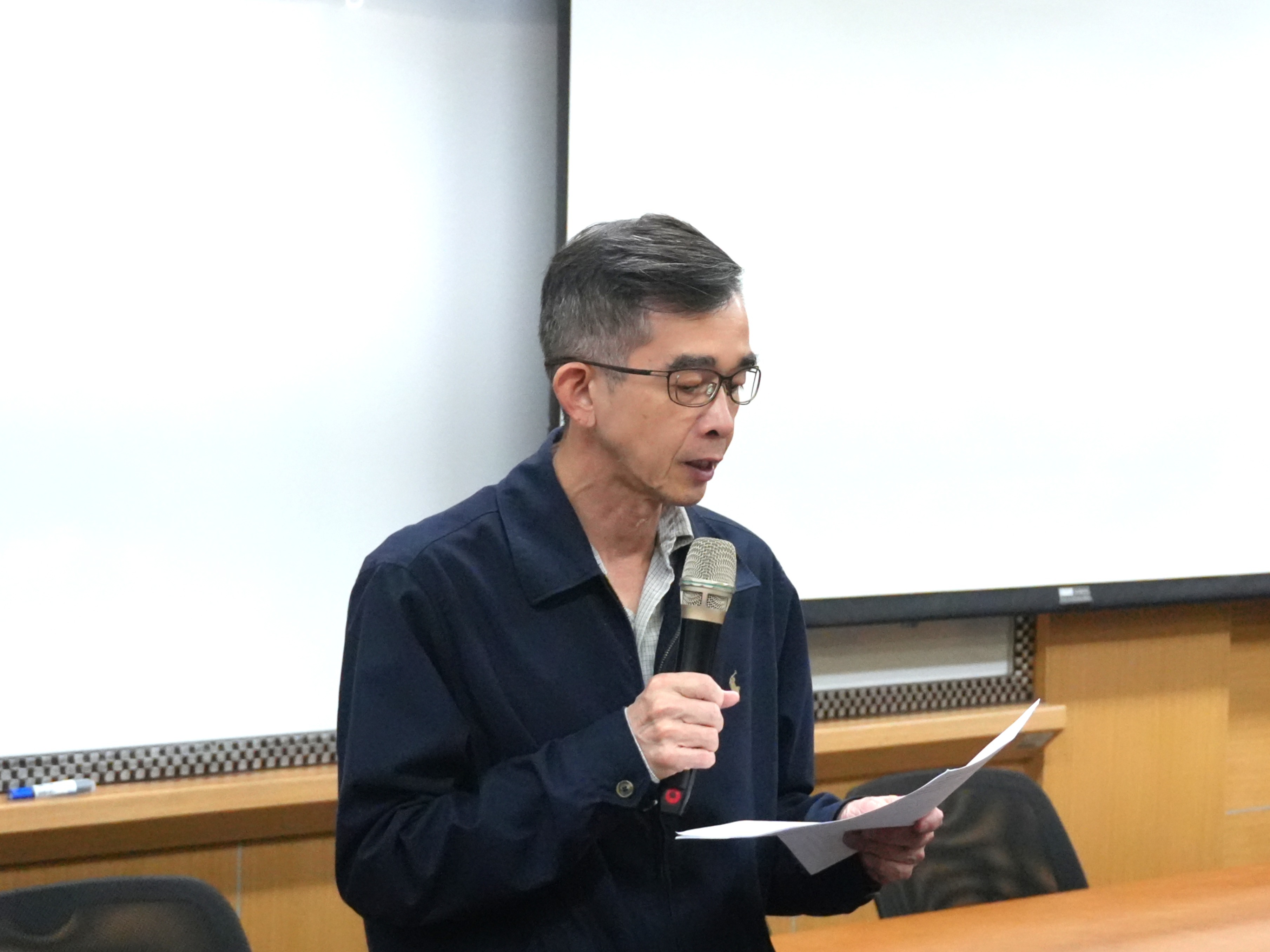
The conference opened with welcoming remarks from Professor Shyh-Jer Chen, Director of CSHCR, who emphasized the symbolic significance of hosting the event in Taiwan and highlighted the importance of succession research for Taiwan’s family-business landscape. This was followed by an address from Professor Heung-wah Wong, a representative of the organizing association and a principal organizer of the conference, who reviewed the development of the Global Family Business Conference and expressed hopes that this year’s meeting would further stimulate collaborative publication initiatives. He noted that family business is a phenomenon that carries economic, social, and cultural meanings, and therefore requires long-term interdisciplinary dialogue.
The conference adopted a hybrid format, bringing together onsite and online participants from management, sociology, anthropology, and business disciplines. Each presentation was followed by active discussion, with scholars engaging in reflections on theoretical approaches, methodological choices, and contextual interpretation. Professor Wong also facilitated multilingual communication in Chinese, Japanese, and English, fostering inclusive and cross-cultural scholarly exchange.
The opening remarks were delivered by Professor Shyh-Jer Chen, Director of the Center.
Day 1 — Rethinking Cultural Meaning, Governance and Gender in Succession
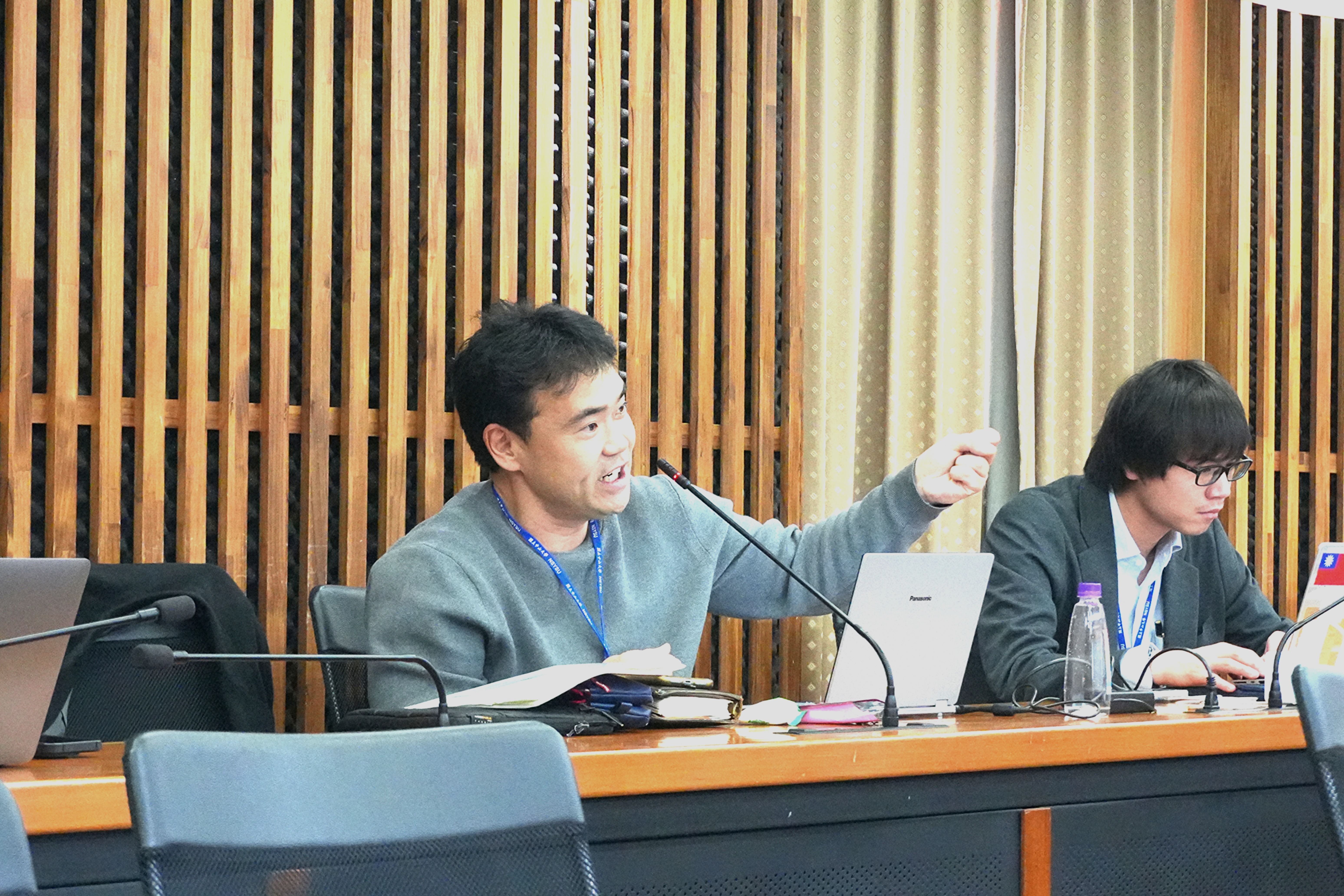
Day 1 featured five research presentations that collectively re-examined succession through the lenses of governance, cultural meaning, identity, and gender in both traditional and contemporary family-business contexts. The program opened with an introductory talk by Professor Heung-wah Wong (Tenri University, Japan), who reflected on mainstream management frameworks in family business research and questioned the extent to which Western-rooted models — such as the overlap between the “family system” and the “business system” — are applicable to Asian and other cultural contexts. He argued that assumptions regarding the separation of household and enterprise, universalized understandings of “family,” and methodological dependence on quantitative approaches may obscure lived experience and actor-level meanings in family firms, calling instead for culturally grounded and historically informed perspectives.
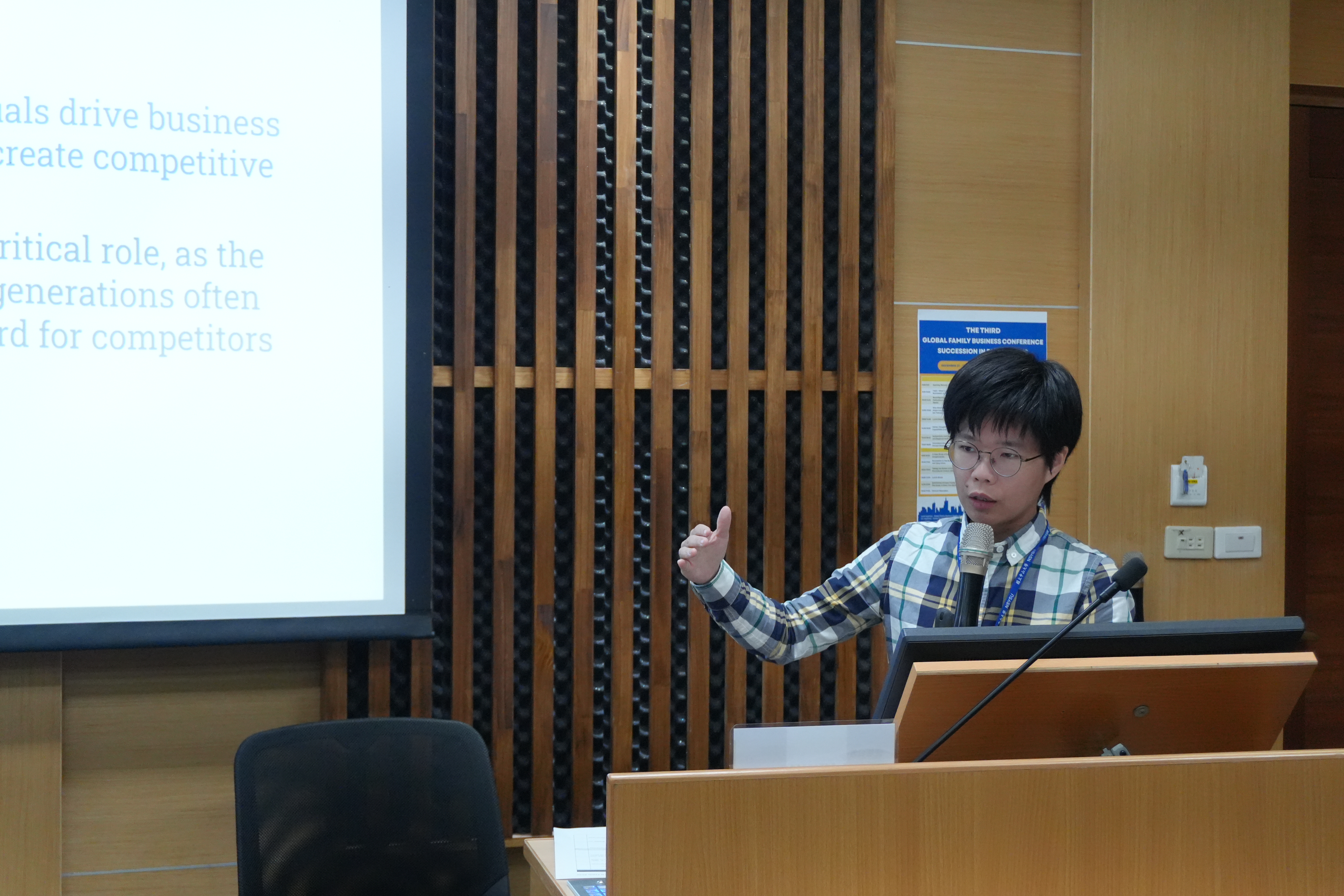
Building on this theoretical opening, Professor Yasuyuki Kishi (Niigata University, Japan) examined succession in the Niigata sake-brewing industry and introduced the concept of “cultural succession,” demonstrating how succession reshapes cultural meaning, local community relationships, and legitimacy in traditional industries. Dr. Yen-Chu Lai (National Sun Yat-sen University, Taiwan) further extended governance-based inquiry through an empirical analysis of Taiwanese listed firms, showing how different socioemotional wealth (SEW) orientations influence CEO succession decisions and succession-planning mechanisms. The conversation then shifted toward gender and intergenerational relationships, as Dr. Chieh-Yu Lin (National Taiwan Normal University, Taiwan) presented case studies of father–daughter succession in Taiwanese manufacturing firms, highlighting complementary capabilities, communication patterns, and trust as key relational foundations for cross-gender leadership transition. The final presentation of the day, delivered by Zhenjing Han (Emlyon Business School, France), examined legitimacy negotiation among Taiwanese female successors in forced-choice succession contexts, revealing how women navigate between external evaluation and self-legitimation through achievement, identity work, and the re-interpretation of gender expectations.
Left: Professor Heung-wah Wong (Tenri University, Japan) delivering the keynote address.
Right: Assistant Professor Chieh-Yu Lin (National Taiwan Normal University, Taiwan) presenting her research.
Day 2 — Lineage Structures, Kinship Ethics, and Institutional Adaptation
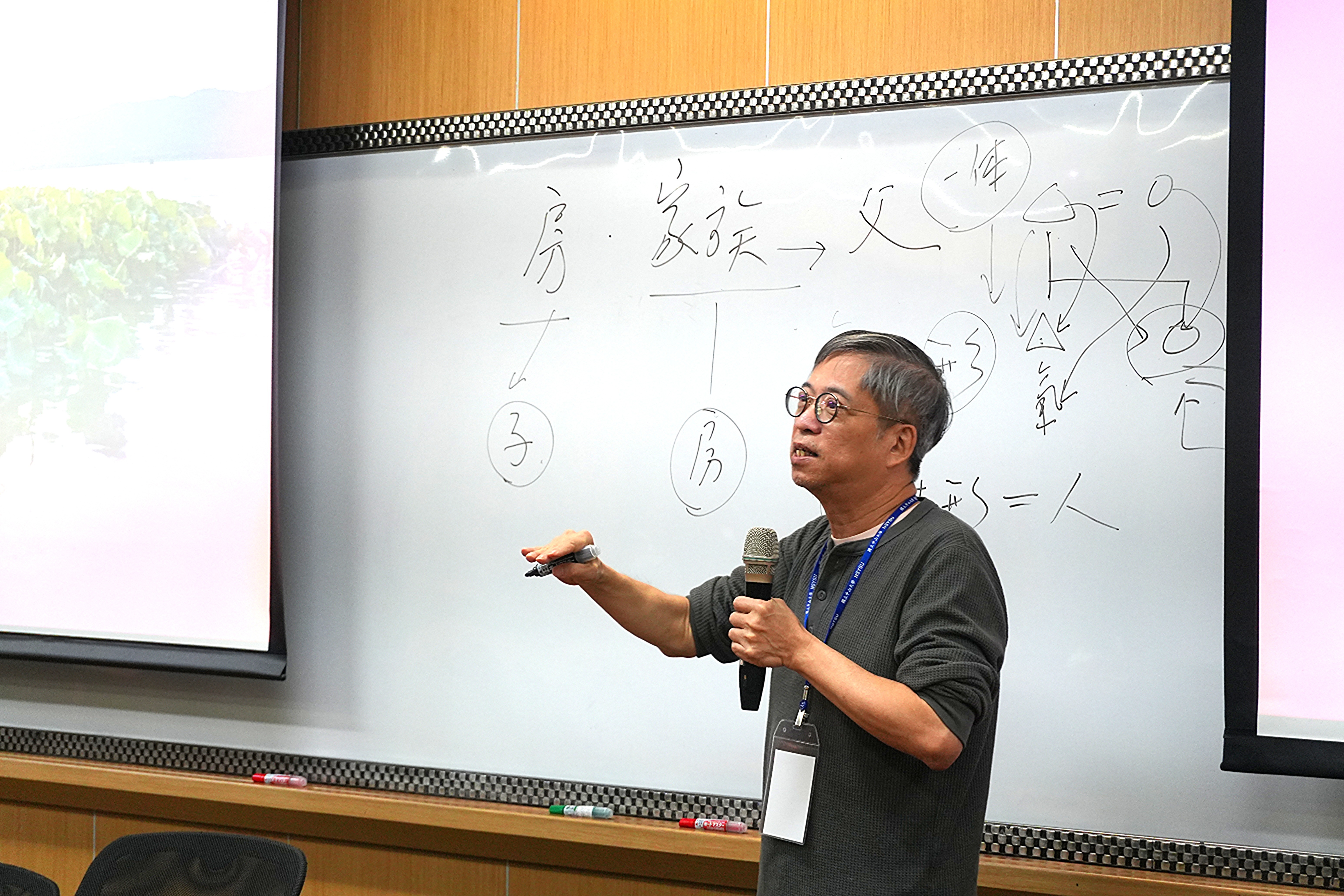
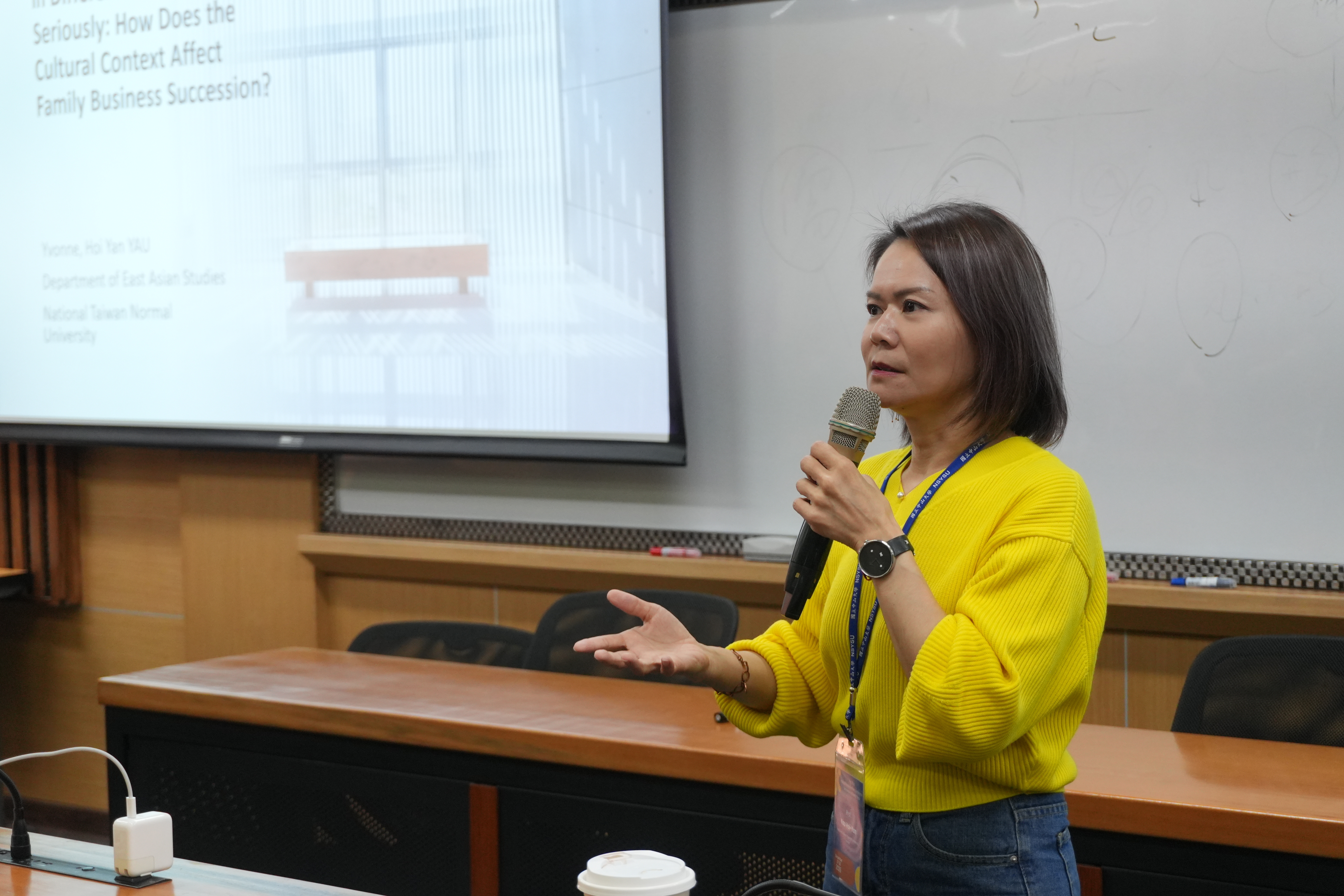
Day 2 extended the discussion by situating succession within historical lineage systems, kinship ethics, and institutional transformation across different geographical and temporal contexts. Opening with a presentation by Dr. Chi Ho Hui (Doshisha University, Japan), the session examined the corporatisation of the Fang / Chia-tsu (房/家族) lineage system through the case of the Y.T. Cheng family and New World Group in Hong Kong, arguing that succession in Chinese family enterprises operates as a long-term structural project embedded in trusts, layered holding platforms, and board composition, rather than as a single generational transfer event. Continuing this lineage-based perspective, Professor Wong presented a historical-anthropological reading of Taihanji (《太函集》), a Ming–Qing period Huizhou merchant text, showing how Huizhou merchants in Ming–Qing China arranged sons’ careers and succession paths according to generational hierarchy, brotherly differentiation, kinship ethics, and filial obligations — demonstrating that business succession was deeply rooted in moral and kinship orders rather than purely economic logic. The theme of culturally specific family concepts was further explored by Associate Professor Yvonne Hoi-Yan Yau (National Taiwan Normal University), whose Japanese case study illustrated how the ie ethos emphasizes the continuity of the corporate family unit as an economic-religious entity, even when leadership transfer involves a son-in-law rather than a biological descendant. The final presentation, delivered by Dr. Tsung-Yuan Chen (Tamkang University, Taiwan), turned to the institutional evolution of Hock Hua Bank in Malaysia, interpreting its 2001 merger not as business failure but as a strategic form of succession in response to regulatory centralization, capital intensification, and professionalization demands — highlighting how kinship-based governance enabled early growth yet required structural adaptation under state-led consolidation.
The closing general discussion began with Professor Wong’s introduction of a preliminary book project. The planned volume seeks to promote interdisciplinary integration, fostering dialogue between management research and the social sciences as an analytical bridge across these domains. Participants reflected on shared themes across the studies—including culture, institutional change, lineage governance, and generational transition—and discussed possibilities for collaborative, integrative publication, with the aim of advancing cross-context and cross-disciplinary perspectives in family business research.
Concluding Remarks
Across two days of scholarly exchange, the Third Global Family Business Conference demonstrated that succession extends far beyond leadership transfer and governance restructuring, encompassing cultural inheritance, institutional adaptation, ethical values, and historical context. Participants collectively reaffirmed the value of sustained interdisciplinary dialogue and expressed hopes for continued research collaboration across cultural and academic boundaries.
Left: Associate Professor Hoi-Yan Yau (National Taiwan Normal University, Taiwan) presenting her research.
Right: Assistant Professor Tsung-Yuan Chen (Tamkang University, Taiwan) presenting his research.

Left: Professor Yasuyuki Kishi (Niigata University, Japan) presenting his research.
Right: Professor Kazunori Sunagawa (Hachioji Chuo University, Japan) presenting his research.