From Regulation to the Management Frontline: Workplace Bullying, Organizational Governance, and the Challenges of Putting New Rules into Practice (2026/09/17)
From Regulation to the Management Frontline: Workplace Bullying, Organizational Governance, and the Challenges of Putting New Rules into Practice
2026/09/17
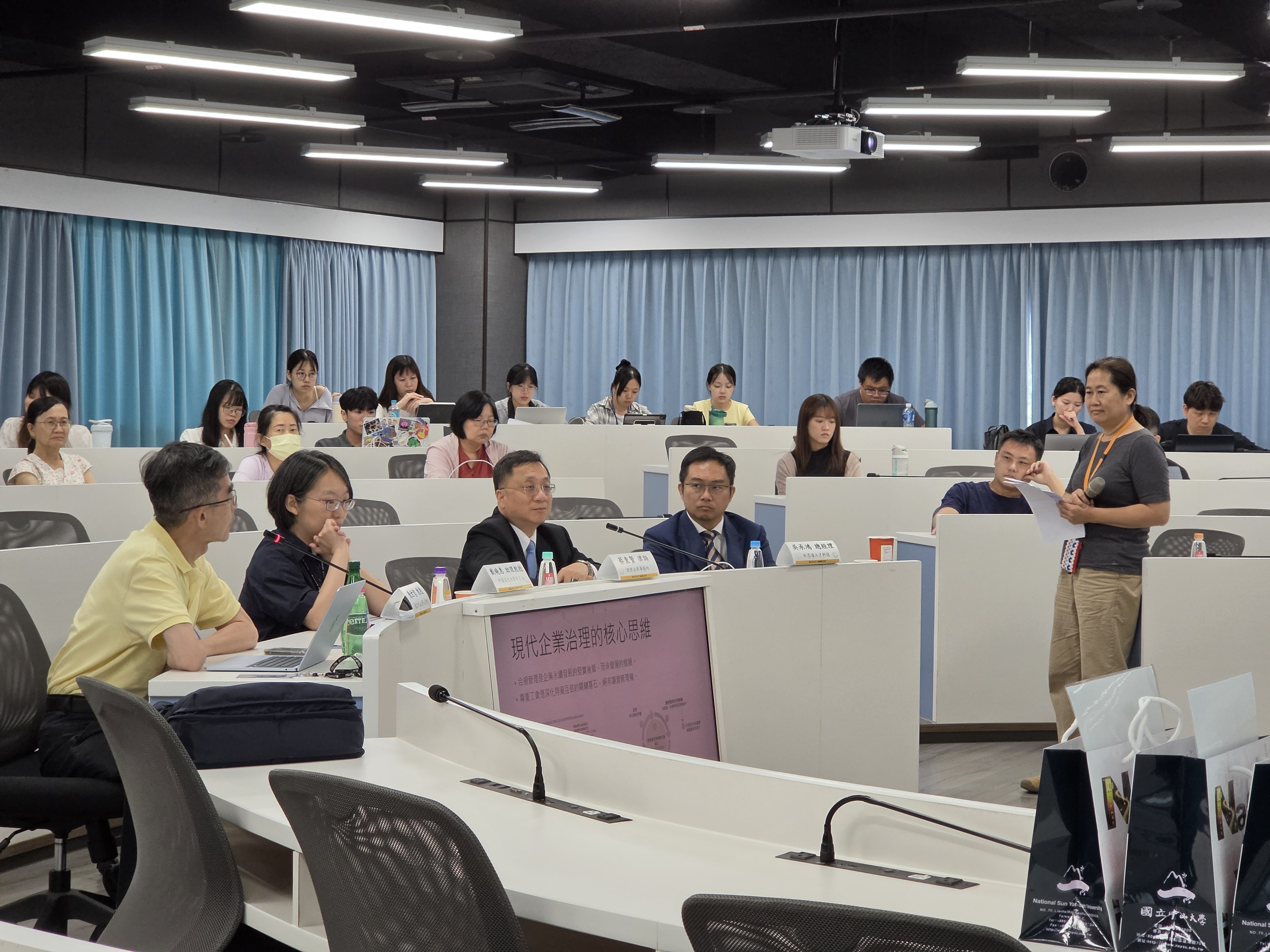
The Centre for Strategy and Human Capital Research (CSHCR) at National Sun Yat-sen University opened its fall program with a cross-disciplinary conversation on an increasingly pressing workplace issue: workplace bullying. On the afternoon of September 17, the Centre hosted a special seminar in its Occupational Safety and Health Act Series, focusing on the new provisions concerning workplace bullying. Co-organized with Synergy Net Application System (好思通人才科技), the event opened with remarks from Professor Pao-Lien Chen, Co-Director of CSHCR.
As workplace bullying prevention becomes subject to more explicit legal and institutional requirements, organizations face a set of questions that extend well beyond legal compliance: How should workplace bullying be identified? What complaint and investigation mechanisms should organizations put in place? And how can employees’ rights be protected without undermining legitimate and effective management?
Beginning with the fundamental question of what constitutes workplace bullying, the four sessions moved progressively toward what organizations should do when complaints arise, how managers can navigate the line between legitimate management and inappropriate conduct, and how more comprehensive mechanisms for labor–management communication and governance can translate regulatory requirements into everyday organizational practice. The four sessions approached this increasingly important issue from different perspectives and attracted students, faculty and staff, and industry professionals, filling the venue to capacity.
Starting with the Legal Boundaries: What Constitutes Workplace Bullying?
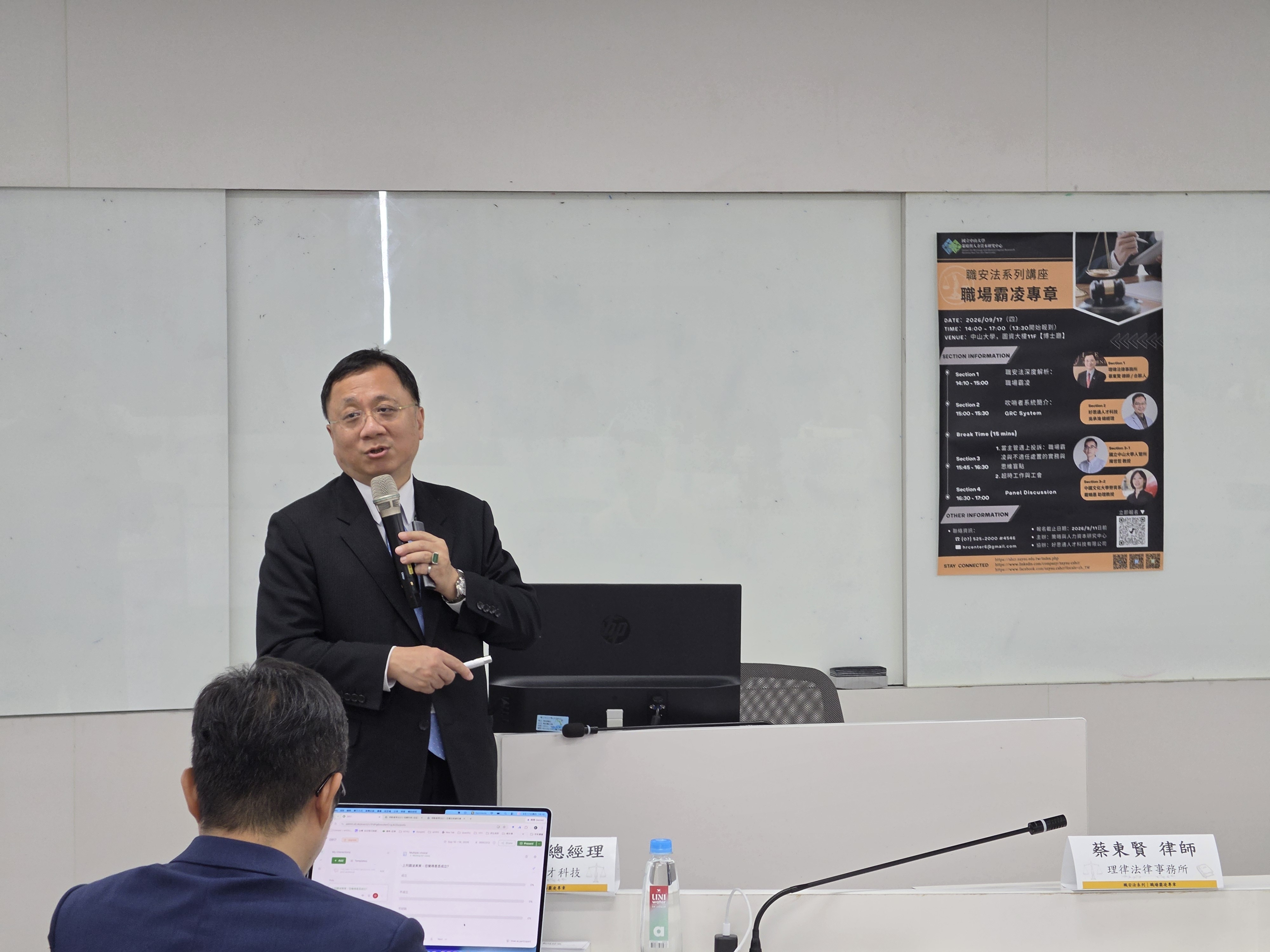
The first session was led by Daniel T. H. Tsai, Partner at Lee and Li, Attorneys-at-Law, who approached workplace bullying through a legal lens, examining both its determination and employers’ responsibilities for prevention and response.
Mr. Tsai began by comparing workplace bullying with workplace sexual harassment to illustrate important differences in how the two are legally assessed. While the determination of sexual harassment places considerable weight on the victim’s subjective perception and experience, an employee’s feeling of having been bullied does not, by itself, establish workplace bullying. Rather, a broader set of factors must be considered, including whether the conduct occurred in the course of work, whether a workplace position or power relationship was involved, whether the conduct exceeded what was necessary and reasonable for legitimate business purposes, whether inappropriate behaviour was sustained over time, and whether it resulted in harm to the employee’s physical or psychological well-being.
This distinction brought into focus a question that would recur throughout the afternoon: Where does management end and bullying begin? Offensive conduct, threats, exclusion, and humiliation may constitute bullying; abuses of authority, unreasonable work demands, and deliberate obstruction may likewise involve inappropriate conduct. Bullying is also not confined to a supervisor–subordinate relationship; disputes may arise between colleagues and, in some circumstances, from subordinates toward supervisors.
Beyond the criteria for determining bullying, Mr. Tsai also outlined the complaint channels, investigation arrangements, processing timelines, appeals, and reinvestigation procedures applicable to organizations of different sizes. Moving from the question of “what constitutes bullying” to “how it should be handled,” workplace bullying prevention requires organizations to do more than simply prohibit certain forms of conduct. It also requires them to establish processes that can be activated when an incident occurs, allowing investigations to be conducted and complete records to be maintained.
From Compliance to Governance: Building GRC Is a Journey
Following the question of how procedures can be translated into practice, Rich Wu, General Manager of HRSR Human Resources Technology, shifted the discussion from legal rules to GRC—Governance, Risk, and Compliance—and organizational case management.
Mr. Wu noted that GRC has developed into a relatively comprehensive set of systems and applications among international corporations, with related mechanisms increasingly incorporated into corporate governance structures. Crucially, GRC is not simply about meeting compliance requirements. It asks organizations to place individual incidents within a broader framework of risk management and corporate governance.
Drawing on court cases and judicial decisions, Mr. Wu highlighted the importance of internal investigation procedures when workplace disputes eventually enter litigation. Whether an organization conducted an investigation, how its investigation team was constituted, and whether interviews and case-handling records were properly documented can all become important bases for subsequent assessment. As time passes, personnel change, and relevant information becomes scattered across emails, LINE messages, and other channels, maintaining a continuous record of complaints, investigations, and case handling also becomes an important aspect of case management.
Such a system can support the entire life cycle of a case—from filing a complaint and uploading evidence to tracking progress and preserving investigation and closure records. More importantly, systematic case management not only supports the handling of individual cases but also allows organizations to identify recurring problems and potential risks through accumulated data.
Building such a system, however, is not a one-off exercise. Mr. Wu described the development of GRC as a journey: beginning with case management, organizations can progressively refine their processes, accumulate data, and feed information back into risk identification and corporate governance. In this sense, the new workplace bullying framework not only brings compliance requirements but also encourages organizations to reassess their internal governance and case management mechanisms.
.jpg)
When Managers Face Complaints: Management Must Continue, but Power Has Limits
Once systems are in place, another question emerges: What does the changing workplace environment mean for those responsible for managing employees on a day-to-day basis?
Professor Chen Shih-Che of NSYSU’s Institute of Human Resource Management brought the discussion to the management frontline with a straightforward question: When employees begin describing management actions as “bullying,” “unfair,” or “targeting me,” can managers still manage?
Professor Chen emphasized that employees have the right to raise complaints, but managers also retain a responsibility to manage. The key lies in clarifying the boundary between the two. Feeling pressured by a supervisor, feeling uncomfortable with the way a manager speaks, or feeling personally targeted does not automatically mean that bullying has occurred. Attention must return to the management conduct itself: whether it is related to work, whether it is necessary and reasonable from a management perspective, and whether the conduct crosses the line into humiliation, threats, personal degradation, or repeated targeting of an individual.
This boundary becomes particularly difficult when managers are dealing with underperforming employees. Through practical cases, Professor Chen explained that managers should not abandon management simply because they are concerned about complaints. Instead, they should engage in continuous performance management by clarifying expectations, identifying performance gaps, providing opportunities for improvement, documenting the process, and evaluating the results.
Rather than making judgments about an employee’s personality, managers should translate concerns into concrete and verifiable behaviours and facts. Documentation is not only for potential disputes in the future; it also provides a basis for the management process itself. A healthy workplace, therefore, is not one in which managers cease to exercise managerial authority. Rather, it is one in which complaints follow a process, management rests on evidence, and power has limits, while both management responsibilities and employee rights are respected.
From Overtime to Unions: Bringing Labor–Management Relations Back into Governance
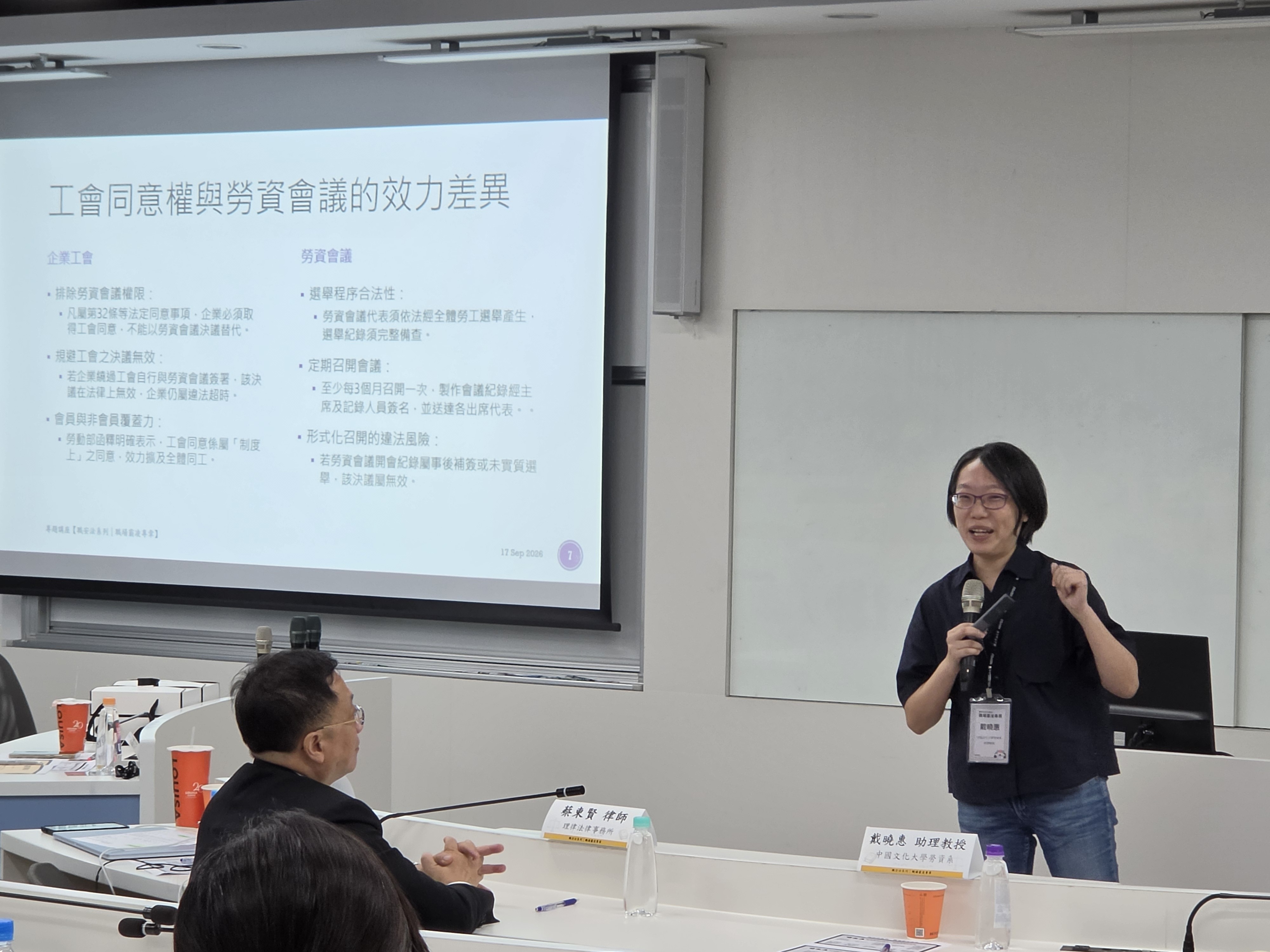
Assistant Professor Tai Hsiao-Hui of the Department of Labor Relations and Human Resources at Chinese Culture University expanded the conversation beyond individual supervisor–employee relationships to the broader architecture of labor–management governance.
Using overtime work as a point of departure, Professor Tai noted that organizations must comply with labor regulations concerning working hours, while certain working-time arrangements also involve the statutory consent of unions and labor–management meetings. Arrangements involving flexible working hours, extended working hours, and certain adjustments to shifts and regular days off may therefore involve the participation of unions or labor–management meetings.
Professor Tai further explained the roles of unions and labor–management meetings in corporate governance. Organizations can incorporate working-hour management and labor–management consultation into everyday systems through communication with unions, sharing information on working hours, and collective agreements. Her presentation also emphasized that respecting unions does not mean surrendering managerial authority. Rather, it provides an important foundation for strengthening labor–management trust and establishing stable communication.
In response to the risk of “hidden overtime” arising from remote work and after-hours communication, Professor Tai also discussed the concept of the right to disconnect. Work assignments communicated through messaging applications after working hours may become evidence of work performed. In addition to maintaining attendance records, organizations can therefore establish clearer rules for after-hours communication and mechanisms for reporting overtime.
From working-hour management and union participation to the right to disconnect, these issues ultimately point back to corporate governance: integrating compliance, labor–management communication, and employee rights into everyday organizational systems, so that labor–management relations can move beyond responding to disputes after they occur toward prevention and institutionalized management.

Bringing Law, Systems, and Management Back to the Same Table
The afternoon concluded with a panel discussion that brought the different perspectives from the four sessions back into conversation. Questions ranged from the risk of being “judged before being heard” once a complaint is filed, to how investigation reports should be provided, whether HR should intervene as a mediator, and whether managers might become reluctant to manage for fear of being accused of bullying. The discussion ultimately touched on a broader question: Will the new workplace bullying framework make workplaces friendlier, or could it increase the distance between labor and management?
The speakers approached these questions from different perspectives, including labor rights, management, and organizational practice. Rather than providing a single answer, the discussion highlighted the tensions involved in putting the new institutional arrangements into practice. On the one hand, formal complaint mechanisms provide employees with channels through which concerns can be raised and remedies sought. On the other hand, being the subject of a complaint may itself create reputational and managerial pressure. How the new framework will be understood, used, and adjusted in actual workplaces will continue to take shape through the practical experiences of organizations, managers, and employees.
As workplace bullying becomes increasingly formalized within legal and organizational frameworks, the real challenge may therefore be more than simply “avoiding violations.” It is also about translating legal requirements into management systems that can function in everyday organizational life: protecting the right to raise complaints, ensuring that cases are handled fairly, and allowing reasonable management to continue.
From legal boundaries and system building to frontline management and labor–management dialogue, the seminar ultimately returned to a shared starting point: a healthy workplace is not created only by seeking remedies after disputes occur. It must be built through consistent management standards, credible procedures for handling complaints, and sustained communication embedded in everyday organizational practice.