From an R&R Manuscript to an Academic Career: Professor Joanna Lin Shares Insights on Publishing and Research (2026/07/09)
2026/07/09
From an R&R Manuscript to an Academic Career: Professor Joanna Lin Shares Insights on Publishing and Research
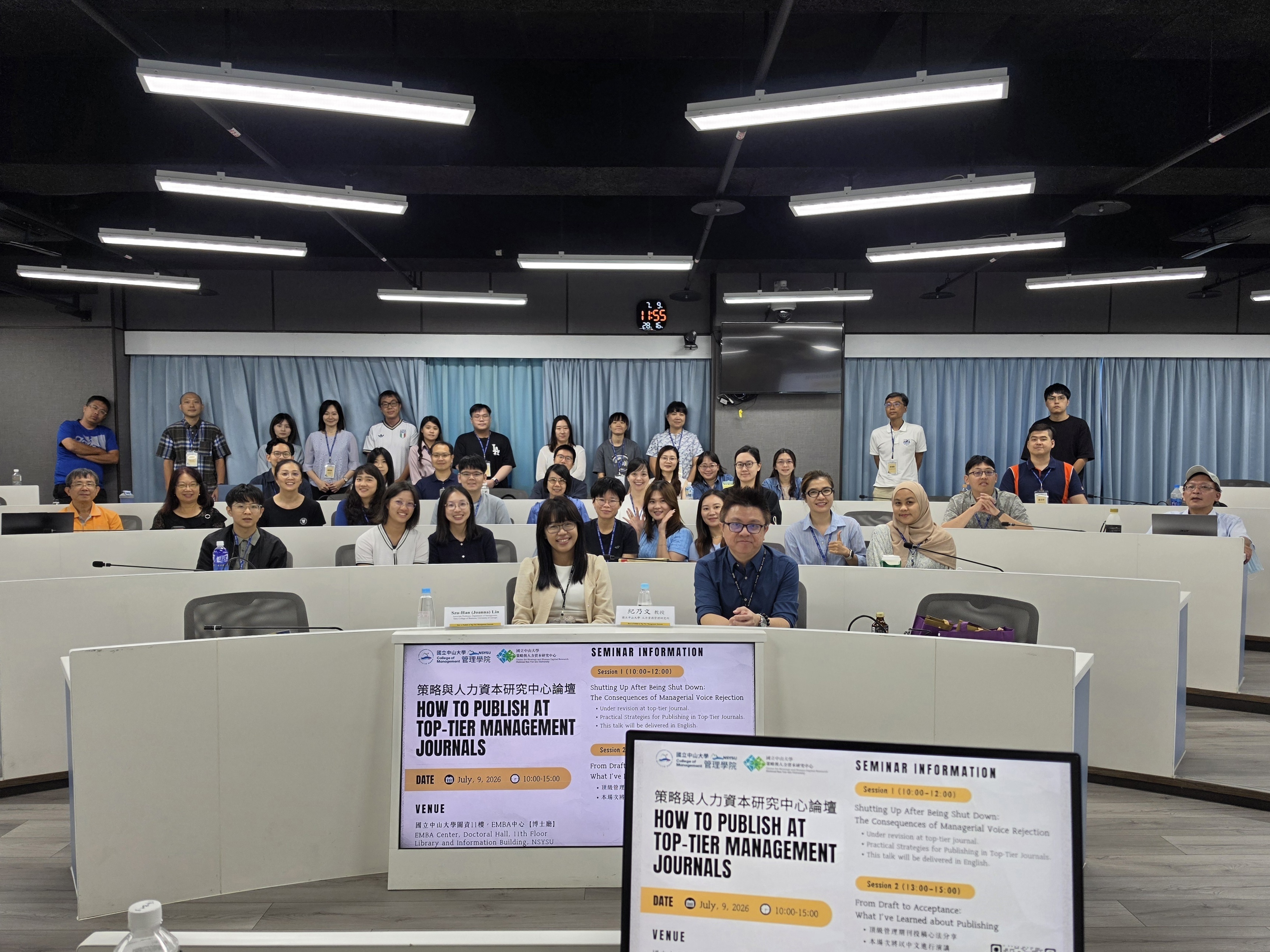
On July 9, 2026, the College of Management and the Center for Strategy and Human Capital Research (CSHCR) at National Sun Yat-sen University welcomed Professor Szu-Han (Joanna) Lin, Associate Professor of Management at the Terry College of Business, University of Georgia, for a full-day workshop on publishing at top-tier management journals. Hosted by Professor Nai-Wen Chi, at NSYSU's Graduate Institute of Human Resource Management, the event drew a full house of postgraduate students and scholars across different institutions. Professor Lin — a recipient of the 2025 SIOP Distinguished Early Career Contribution Award and a member of the editorial boards at Academy of Management Journal (AMJ), Journal of Applied Psychology (JAP), Organizational Behaviour and Human Decision Processes (OBHDP) and Personnel Psychology — spent the morning in English and the afternoon in Mandarin. Across both sessions, she shared first-hand insights into research design, theory development, publication strategies, and academic career development, offering participants a deeper understanding of the thinking behind top management research.
Learning from an R&R Manuscript: Understanding the Revision Process in Top-tier Management Journal Publishing
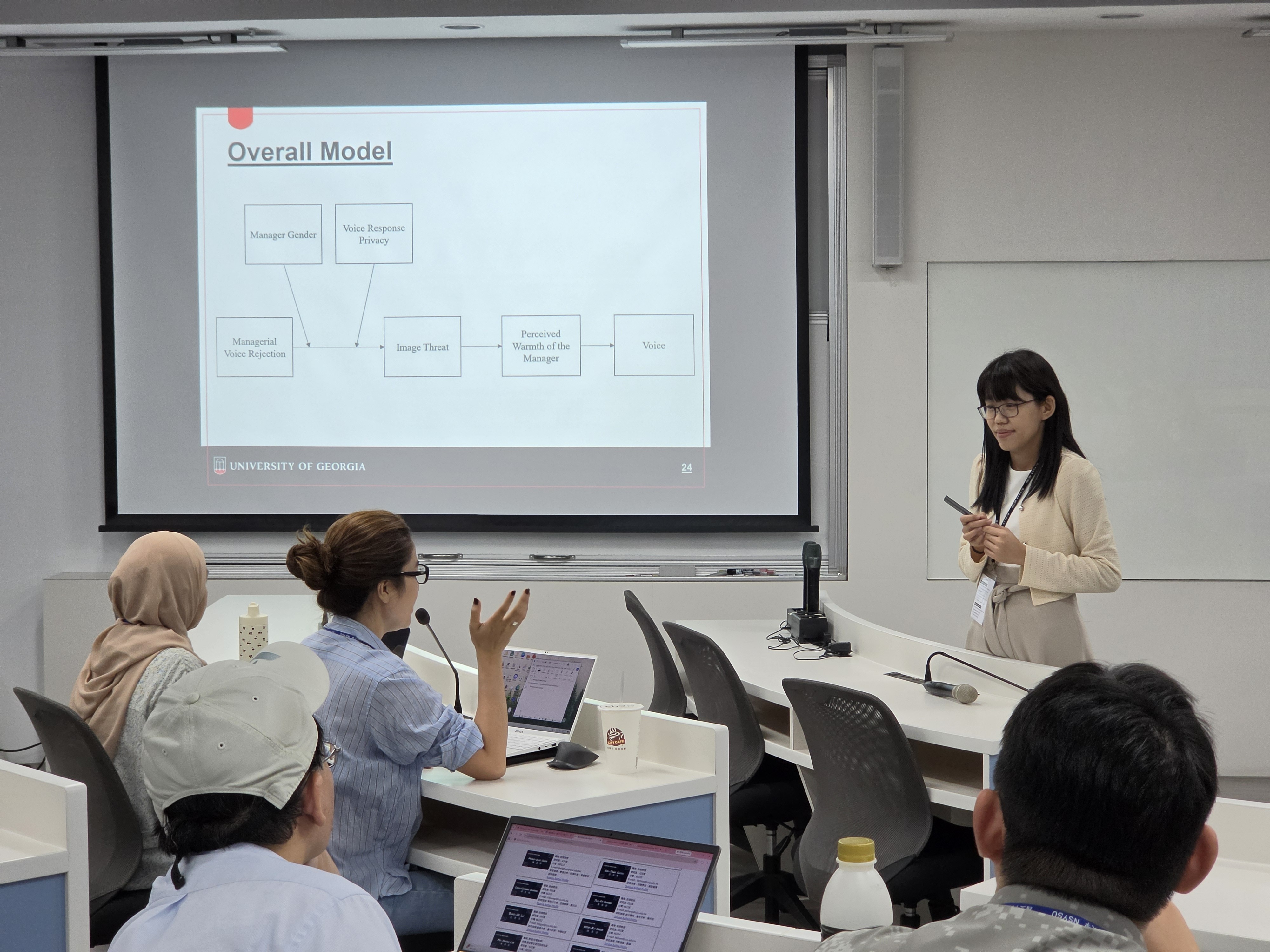
Using a manuscript currently undergoing the Revise and Resubmit (R&R) process at a top management journal as a case study, Professor Lin demonstrated how a research project—specifically one centering on employee voice—evolves. She illustrated how the work is refined through theoretical development, multiple studies, and successive rounds of peer review, including strategic responses to reviewer and Associate Editor (AE) feedback.
Professor Lin also discussed the role of Associate Editors (AEs) in shaping the direction of a manuscript during the review process. She noted that authors need to balance reviewer feedback with preserving the core theoretical contribution of their work. She emphasized that revision is not simply about adding analyses or responding to comments, but often requires researchers to revisit their research questions, theoretical positioning, and overall narrative structure.
Drawing on her own publication experience, Professor Lin reflected on how her approach to responding to reviewer feedback has evolved over time. She encouraged participants to gradually develop independent scholarly judgment and confidence throughout the publication process. An interesting parallel emerged from Professor Lin’s session: while the research she shared focused on employee voice behavior, her own publication experience illustrated how researchers navigate questions, feedback, and revisions from editors and reviewers throughout the publication process. From the research topic itself to the process of academic publishing, both reflected how individuals deepen and refine their ideas through continuous dialogue and adjustment when facing different perspectives and challenges. This connection also made the otherwise abstract journey of academic publishing more concrete, allowing participants to engage more deeply and resonate with the experience.
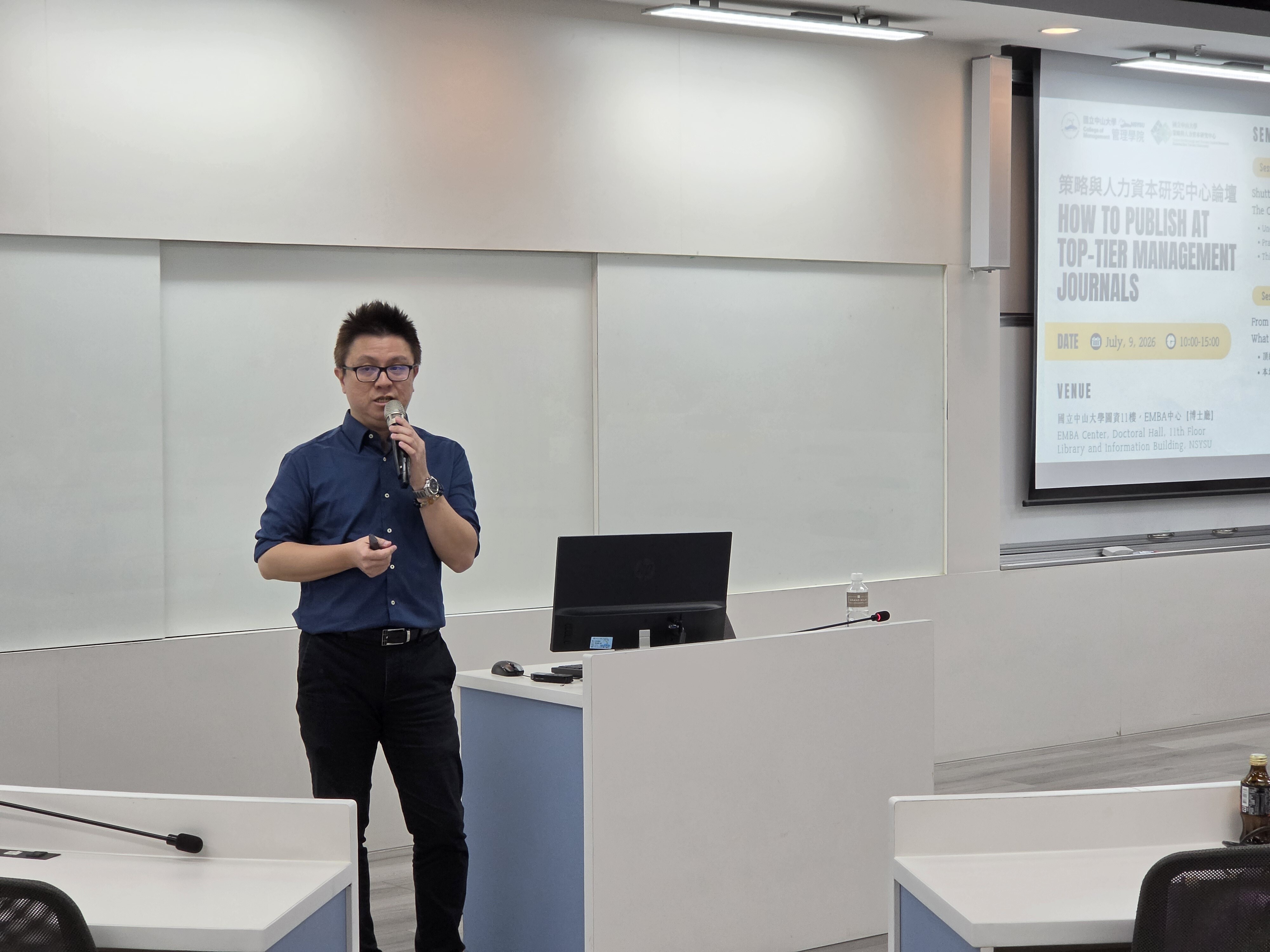
As the session closed, Professor Nai-Wen Chi shared his own reflections on the morning's themes before opening the floor. Questions continued slightly beyond the scheduled end, covering topics such as research design, theory development, data collection, and publication strategies. Discussions naturally continued into the lunch break, where many participants took the opportunity to exchange further ideas with Professor Lin, reflecting the strong interest in research and academic publishing among attendees.
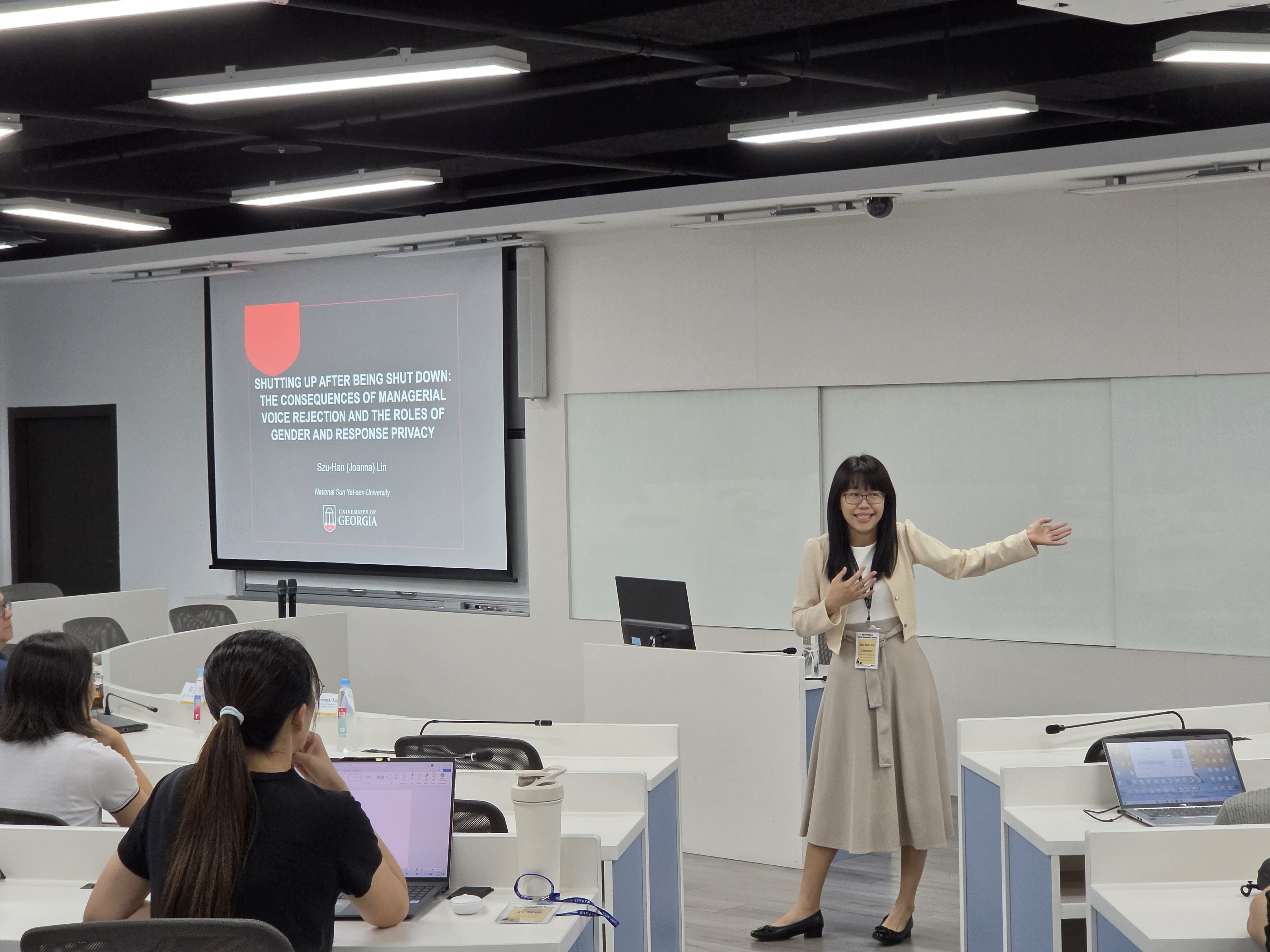
The Afternoon: Publishing as a Craft, and a Career
The afternoon session broadened the discussion from a single manuscript to research methodology, academic writing, publication strategies, and long-term academic career development. Professor Lin also shared reflections on her academic journey, emphasizing that research ability is developed through continuous learning, refinement, and experience.
A major focus of the session centered on what constitutes a meaningful theoretical contribution. Professor Lin stressed that high-quality research should not begin with selecting variables or identifying an unexplored "gap" in the literature. Instead, researchers should first identify an important organizational phenomenon, establish a coherent theoretical story, and then determine appropriate constructs, hypotheses, and research designs based on that theoretical foundation. She further explained that compelling research often challenges existing assumptions or reframes how a phenomenon has traditionally been understood, rather than merely extending previous studies with additional variables. Throughout the session, she repeatedly emphasized the importance of developing a coherent research narrative in which every component of the study—from theory to empirical testing—contributes to answering the same central research question. Professor Lin also shared practical advice on research design, measurement selection, aligning theory with methodology, and common issues frequently raised during peer review.
Drawing on examples from her own research and publication experiences, Professor Lin also shared practical strategies for strengthening academic writing. She encouraged participants to study the introductions of published articles carefully, not to imitate the wording, but to understand how experienced scholars frame research questions, position theoretical contributions, and construct persuasive arguments. She explained that successful academic writing relies more on mastering the underlying logic and structure of a paper than on sophisticated language itself. To cultivate this ability, she described how she organizes exemplary articles into personal reference folders according to their framing strategies and research logic, using them as learning resources when developing new manuscripts.
Beyond publication strategies, Professor Lin also discussed sustaining a long-term academic career through effective time management, continuous learning, and resilience. She encouraged participants to remain motivated and proactive throughout their research journeys, continually adjusting priorities at different stages of the process to maintain lasting research productivity.