
When AI Meets Talent Development: Andrew Weaver's Insights on U.S. Manufacturing (2026/05/15)
2026/05/15
When AI Meets Talent Development: Insights from Andrew Weaver on Skills and Training in U.S. Manufacturing
Topic: Technology, Training, and Skill in U.S. Manufacturing
Is the Skills Gap Real — or Are We Just Not Training Enough?
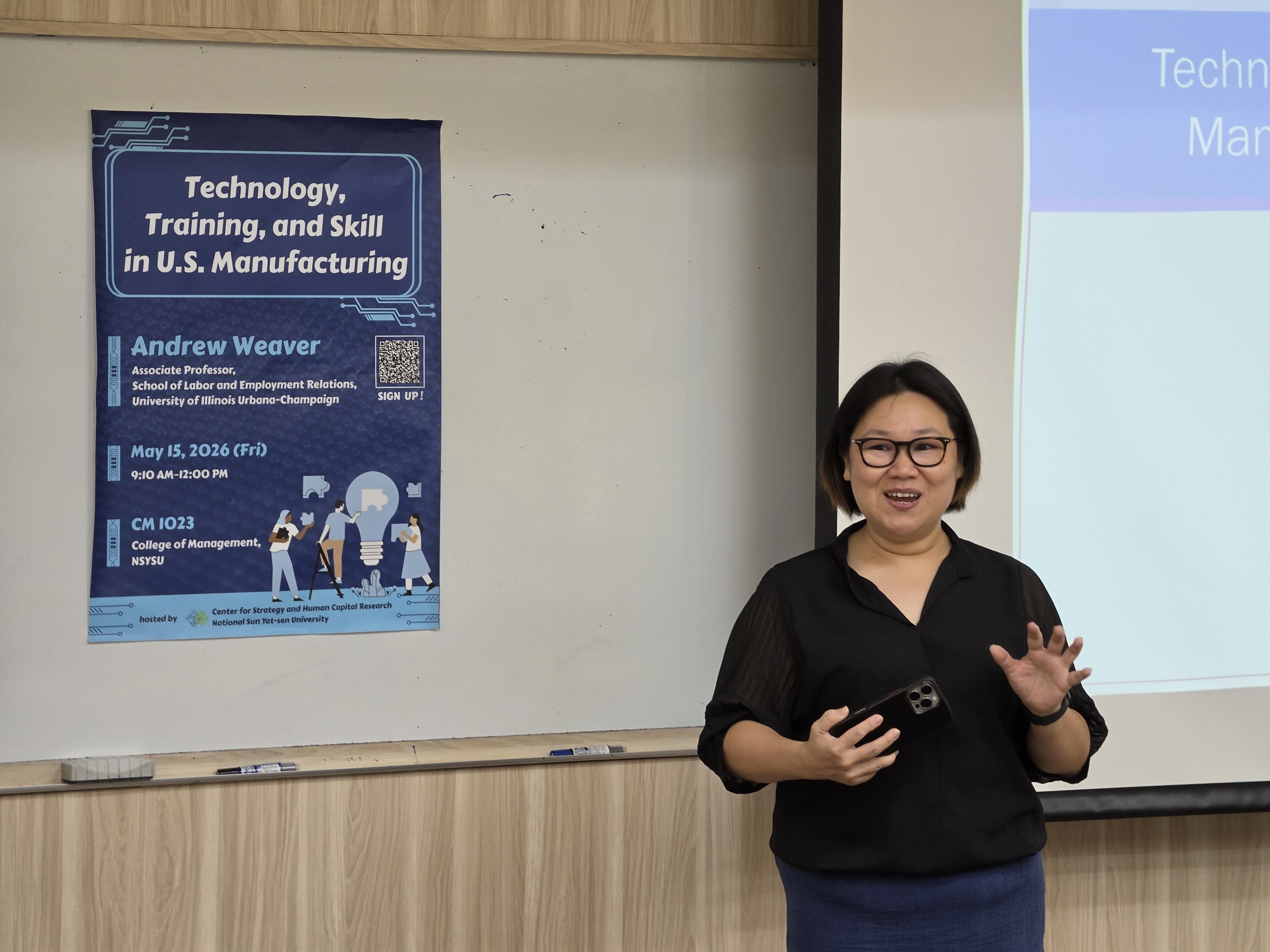
On the morning of May 15, 2026, the NSYSU Center for Strategy and Human Capital Research (CSHCR) welcomed Andrew Weaver, Associate Professor at the School of Labor and Employment Relations, University of Illinois Urbana-Champaign, for a lecture titled Technology, Training, and Skill in U.S. Manufacturing. Faculty and students from the College of Management packed the room, and the energy stayed high throughout.
Part of what made the session work so well was Prof. Weaver himself. A MIT-trained labour economist who spent years as a banker and business consultant before entering academia, he moved comfortably between rigorous data and real-world implications without losing the room to jargon. His research draws on evidence from both the United States and South Korea, lending a comparative dimension that resonated with the Taiwan audience. The talk covered three themes: trends in workplace training, how robot adoption affects skill demands, and — the section that sparked the most discussion — what the data actually says about AI and the labour market.
.jpg)
Part I: The Quiet Collapse of Training in U.S. Manufacturing
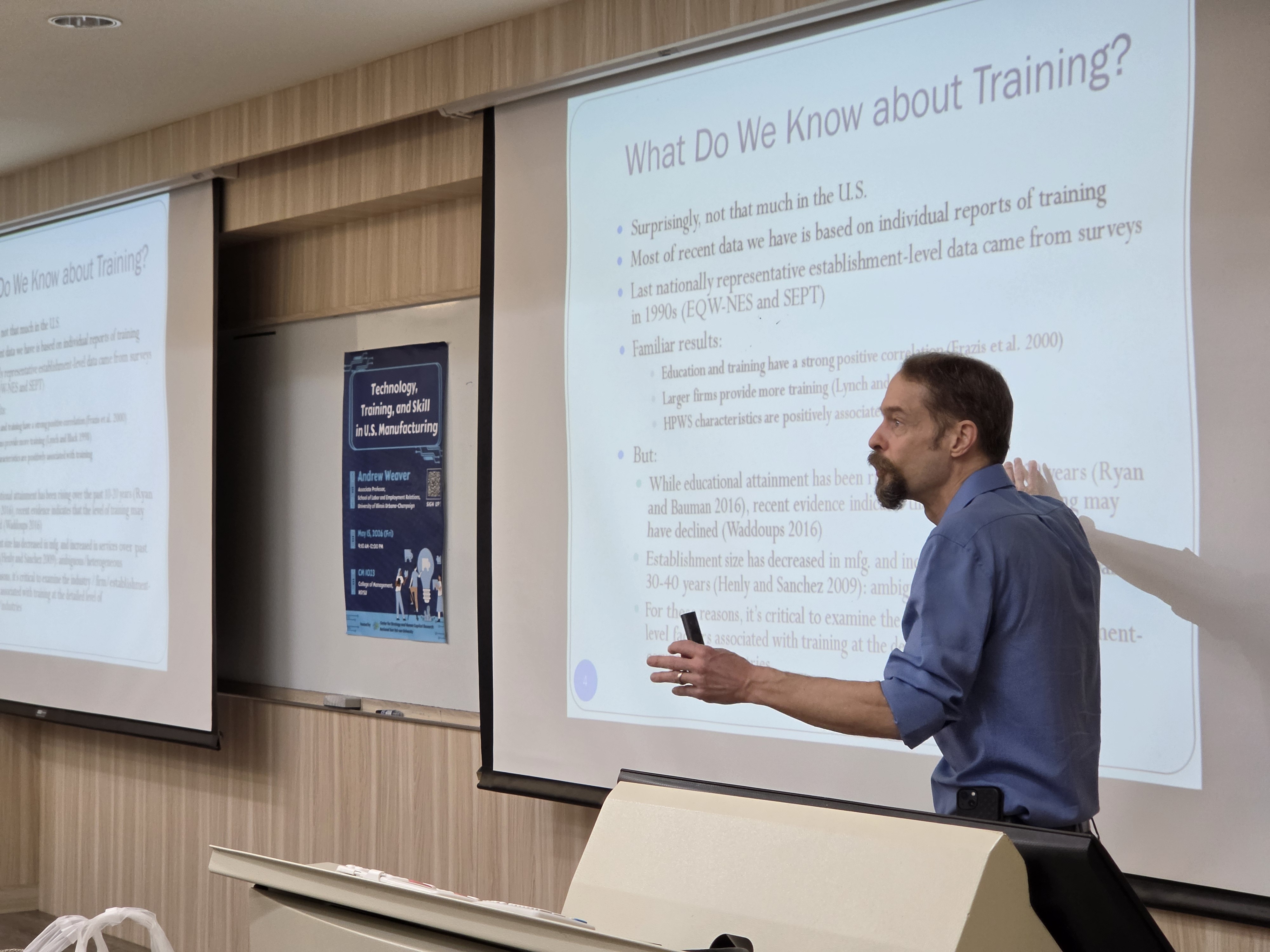
Prof. Weaver opened with a striking finding from his own research. Working with Paul Osterman (MIT), he conducted a nationally representative survey of U.S. manufacturing plants in 2012–2013 — the first employer-side data of its kind since a similar study in 1995. The comparison was stark: the share of plants providing formal training to production workers dropped from about 75% in 1994 to roughly 55% in 2012 — a 20 percentage point decline that held across virtually every industry. The only exception was food and beverage, where a government regulation had mandated training the previous year. Where no such rule existed, training fell.
Why the decline? Several factors were implicated. As IT capital grew as a share of total plant investment, formal training hours fell; robot adoption showed a similar pattern. A key conceptual thread helped make sense of this: firms are reluctant to fund general skills that workers can take to a competitor, but more willing to invest in specific skills only useful in-house. The rise of IT and automation may have shifted training away from the general and formal toward the specific and informal — or in some cases, away from training altogether.
The broader industrial shift in the U.S. also played a role. As competition from China pushed surviving manufacturers toward product innovation and R&D — and away from the model of highly-trained, efficiency-oriented frontline workers — training investment followed. One counterintuitive finding: the percentage of workers with community college credentials did not show a strong or statistically precise correlation with formal training at the plant level, while four-year degrees did, suggesting that company training tends to reinforce existing advantage rather than address gaps at the bottom.
A useful contrast came from his Korean research: as educational attainment surged in South Korea, manufacturers there increased training, viewing a more educated workforce as better able to benefit from it. The divergence between the two countries suggests the relationship between education, technology, and training is shaped as much by managerial culture as by market forces.

Part II: Do Robots Raise or Lower Skill Demands?
The second section used a database of all U.S. job postings from 2010–2022, tracking what skills factories asked for before and after adopting robots. The initial finding looked promising: post-adoption, plants asked for more computer literacy and more specialized engineering skills — suggesting technology was raising skill demands.
The complication: when the team checked non-technical skills like sales and accounting, they saw the exact same pattern. Which raised an obvious question: maybe it wasn't the robots driving this at all, but some broader surge in business activity that coincided with robot adoption. After more careful analysis, a real signal did emerge for general computer literacy, but the data revealed that robot adoption surprisingly did not intensify demands for specialized skills such as CAD-CAM.
Prof. Weaver was candid about where the research stands: "The jury is still out. Six months from now I could be telling a completely different story." The methodological point he wanted to leave with the room: results that look clean on first inspection often get complicated when you dig in — a good reason to be sceptical of the confident trend claims that often circulate in business media.
Part III: AI and the Labor Market — Reasons to Pump the Brakes
This was the section that generated the most energy in the room, with questions ranging from AI's effect on specific industries to the growing trend of universities cutting humanities programs. Prof. Weaver wasn't dismissing AI's importance, but he pushed back on several popular claims with specific evidence.
The narrative that AI is already displacing young workers, he argued, doesn't hold up on timing: the decline in job-finding rates among young graduates started in the 1990s — well before generative AI arrived. On productivity, recent gains above pre-pandemic forecasts are largely explained by lower-productivity workers being laid off first during the pandemic, not by a genuine technological leap. A large international survey found that between 79% and 91% of executives across various countries stated that AI has had no measurable impact on their company's productivity in the past three years. And historically, transformative technologies take decades to show up in productivity data — electricity took roughly 40 years to meaningfully move the needle after it was invented.
Perhaps more importantly, research suggests that when AI does boost productivity, it tends to do so through innovation and new value creation rather than simple cost-cutting. Firms that deploy technology to innovate rather than just to replace workers tend to see better outcomes on both productivity and employment. That distinction, Prof. Weaver reminded the room, comes down to management decisions. "You're going to have an important role to play in determining what impact AI has on both productivity and on workers."
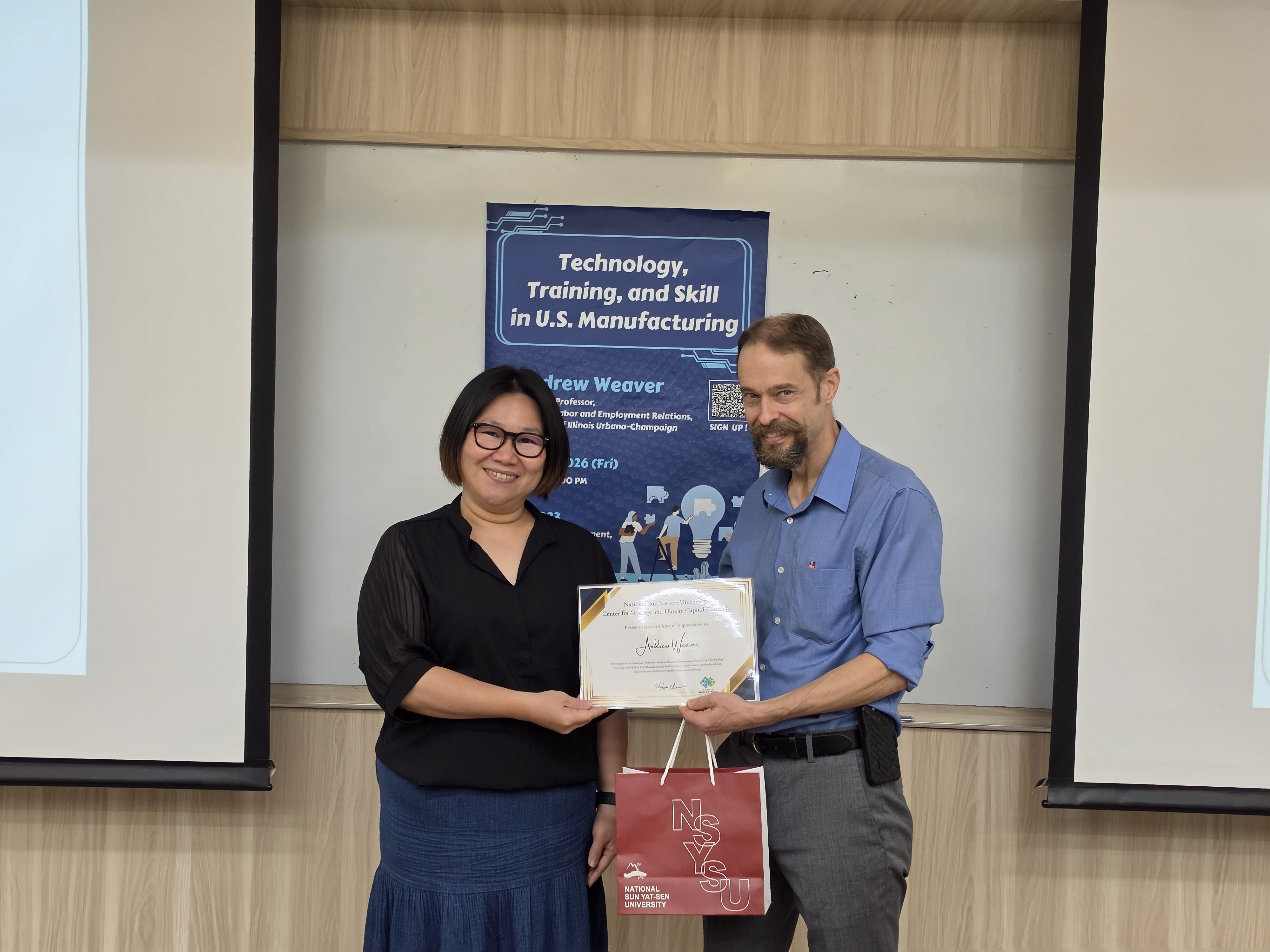
The event closed warmly, with the Center presenting Prof. Weaver with a certificate of appreciation and a gift. The small groups of attendees afterward to continue the conversation with Prof. Weaver were a fitting measure of a morning well spent.

Prof. Weaver's core message runs through all three sections: what matters is not simply whether technology is adopted, but how, by whom, and with what investment in people alongside it. In a moment when AI commentary tends toward either panic or hype, a grounded, data-first perspective is exactly what the conversation needs.
